Labour, Media Reform and the Missing Civic Conversation
The Labour government is beginning to assemble a substantial programme of media policy. BBC Charter renewal is under way. A new Media Green Paper considers the future of Public Service Media and the prominence of trusted news online. The Amplify Local Media Action Plan addresses the sustainability of local journalism. Ofcom is being encouraged to consider growth, innovation and regulatory reform.
Taken individually, these are significant interventions.
Taken together, however, Better Media believes they raise a more fundamental question: where is the joined-up discussion about what kind of media system the UK actually needs?
An Emerging Media Policy
There are some important principles running through current government policy.
The BBC Charter Review includes questions about media plurality, the BBC’s impact on local media markets, technology, innovation, social cohesion and digital inclusion. It also considers how the BBC might work more effectively with other parts of the media ecology.
The government’s Amplify Local Media Action Plan similarly recognises the democratic importance of locally rooted media. It links local journalism with scrutiny of public institutions, trustworthy information, social cohesion, civic engagement and community wellbeing. It proposes measures intended to improve the financial sustainability of local journalism, support digital transition, develop relationships with the BBC and technology platforms, and sustain public-interest reporting.
The Media Green Paper goes further in recognising the changing communications environment. It considers the future of Public Service Media, the migration of television towards internet distribution and proposals intended to make trustworthy news providers easier to find on social platforms. The government’s own framing explicitly connects the media system with social cohesion and a healthy democracy.
These are useful starting points.
But they do not yet amount to a comprehensive account of media reform.
The Institutional View Of Media
One concern is that much of this discussion continues to begin with institutions.
The BBC Charter Review naturally begins with the BBC. Public Service Media reform largely begins with the established broadcasters. Local media policy is principally concerned with sustaining professional journalism and established local-news provision. Creative-industries policy tends to concentrate on investment, intellectual property, employment, innovation and economic growth.
Each of these objectives has a legitimate place in public policy.
The difficulty comes when they become the boundaries within which media policy itself is imagined.
A media ecology consists of more than broadcasters, publishers, production companies and technology platforms. It also encompasses community radio, independent journalism, community newspapers, podcasts, newsletters, photography, citizen reporting, independent video, cultural media, archives, creative audio, local digital platforms and numerous other forms of civic communication.
It includes organisations whose principal purpose may not be commercial growth or audience scale.
And, importantly, it includes citizens themselves.
From Media Consumption To Civic Participation
This produces a significant gap in the emerging policy discussion. Government policy increasingly asks how people can obtain trustworthy information. Better Media also wants to ask how people gain the capacity to participate in producing, sharing, discussing and governing information. Those are related but different objectives:
- A healthy democratic communications system cannot be understood solely as a mechanism for delivering professionally produced information to audiences. It must also provide opportunities for people to participate in the conversations through which communities understand themselves.
- That means considering communication as part of civic infrastructure.
- Libraries are not normally justified solely according to the commercial value of books borrowed. Parks are not judged simply according to their capacity to generate economic growth. Cultural venues, educational institutions and community organisations provide spaces in which social relationships and civic capacity are developed.
There is a case for thinking about media infrastructure in similar terms.
Better Media has been developing the concept of Foundational Media to describe this layer of communications activity: locally rooted, participatory and civic media that enables people and organisations to communicate, document experience, exchange knowledge and contribute to public life.
This does not require replacing professional journalism, commercial media or Public Service Media.It means recognising what is currently missing between them.
Policy Without A Common Framework
Another concern is the apparent separation between policy discussions that are addressing closely related problems:
- BBC reform considers public purposes, trust and social cohesion.
- Local-media policy considers democratic accountability, trustworthy journalism and community engagement.
- Platform policy considers discoverability and the power of intermediaries.
- Media-literacy policy considers people’s ability to interpret and navigate information.
- Creative-industries policy considers innovation and economic development.
- Civil-society policy considers participation, belonging and civic renewal.
Yet, these conversations rarely appear to meet within a common communications policy framework.
Better Media’s observation is that this separation makes it harder to consider alternatives to the established institutional model.
For example, the Amplify plan contains strong language about empowering communities, strengthening social cohesion and supporting civic engagement. But its principal mechanisms remain interventions in the professional local-news market, particularly support for publishers, journalism and associated business models.
Similarly, the BBC Charter Review recognises plurality and the wider local-media ecosystem, but the starting point remains how the BBC should operate within and support that ecosystem.
There is another possible starting point.
What communications infrastructure does a healthy democratic society require, and what mixture of public, commercial, independent, cooperative, community and civic organisations would best provide it?
Moving Beyond Economic Sustainability
Sustainability clearly matters. Community and independent organisations cannot operate without resources. Journalists need to be paid. Infrastructure costs money. Organisations need viable business models.
But economic sustainability is a means rather than the sole purpose of media policy.
The wider objectives include democratic participation, scrutiny, cultural expression, belonging, media literacy, social connection, creative experimentation and the ability of communities to tell their own stories.
The challenge is therefore not simply to make existing media institutions financially sustainable. It is to make the communications ecology itself sustainable, plural and participatory. This distinction becomes particularly important when policy discussions turn towards growth.
Growth might mean larger organisations, increased investment and commercially scalable services. But it might equally mean more organisations capable of operating sustainably, more communities with access to communications resources, wider participation, stronger local networks and a greater diversity of voices.
Media policy needs to be clear about which forms of growth it wants to encourage.
Questions Better Media Wants To Discuss
As people gather at Labour Party Conference to discuss the BBC, local journalism, digital platforms, the creative industries, democracy and civil society, Better Media would like to see some additional questions placed alongside those discussions.
- What would UK media policy look like if it began with the communications needs of citizens and communities rather than the requirements of existing institutions?
- Should civic and community media be recognised as a distinct component of the UK media ecology alongside Public Service Media and commercial media?
- What does media plurality mean if people can choose between many outlets but ownership, infrastructure and distribution remain concentrated?
- How can public funding encourage new forms of media provision rather than primarily sustaining incumbent organisations?
- Could BBC partnership obligations extend beyond established publishers to community, independent, cooperative and civic media organisations?
- Who should qualify as a provider of trustworthy or public-interest media, and how can new entrants gain recognition without creating another closed institutional system?
- Should public communications infrastructure include shared access to data, archives, technology, training, production resources and distribution networks?
- How can community media, media literacy and civic participation be connected rather than treated as separate policy fields?
- What role should locally rooted media play in wider programmes concerned with civic renewal, neighbourhood participation and democratic engagement?
- How should the success of media policy be measured beyond audience size, investment, employment and economic growth? Could measures of participation, plurality, social gain and civic capacity sit alongside conventional economic indicators?
- How can regulatory reform encourage new entrants and experimentation without inadvertently accelerating consolidation among already powerful media organisations?
- What would it mean to treat access to communications capability as part of the foundational infrastructure of everyday civic life?
These are not arguments against the BBC, professional journalism, commercial media or the creative industries.
They are questions about what sits around, underneath and between them.
Connecting Media Reform With Civic Renewal
There is potentially much to work with in the government’s emerging media programme. The language of plurality, trusted information, locally rooted media, social cohesion, innovation and public value provides openings for a wider discussion. The Local Media Action Plan explicitly describes its proposals as only the beginning of a longer process requiring government, industry, civil society and citizens to work together.
Better Media wants that conversation to go further:
- Media reform should not simply determine how established organisations survive technological change. It can also ask how communications policy contributes to civic renewal.
- That means considering the places, organisations, skills, technologies, networks and resources through which people develop the capacity to participate in public communication.
- It means moving from thinking only about media institutions towards thinking about media infrastructure.
- And it means recognising that the future of democratic media might emerge not only from the reform of existing national institutions, but through thousands of locally rooted, independent and collaborative forms of communication.
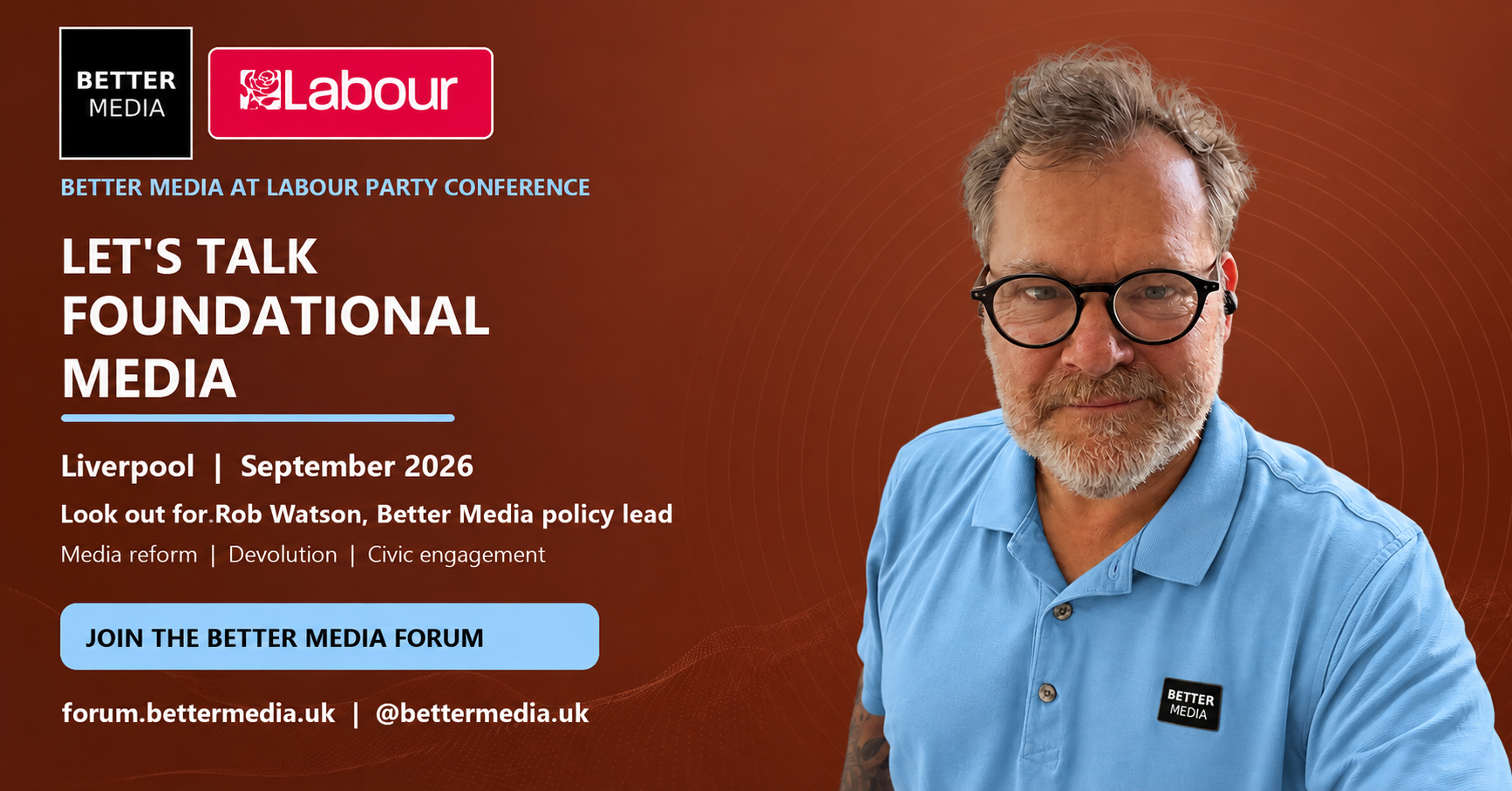
Better Media’s Rob Watson will be attending Labour Party Conference and is interested in meeting people working on media reform, public service media, local journalism, community media, civic renewal, media literacy, platform policy and related issues.
If you are attending and would like to compare ideas, discuss these questions or simply have an informal conversation about what a more plural and participatory UK media settlement might look like, please get in touch.
The purpose is not to arrive with all the answers.
It is to make sure we are asking a sufficiently broad set of questions.